While the world turns its eyes to Puri for the annual chariot festival, a centuries-old tradition unfolds along the quiet riverbanks of West Bengal’s Hooghly district. In the historic town of Guptipara, faith manifests not just in prayers and pulling ropes, but in a chaotic, thrilling, and sacred spectacle known as Bhandar Loot (or Bhog Loot). 
Celebrated continuously since the 1740s, the Guptipara Rath Yatra is second only to Puri in terms of the distance covered by the chariot. However, its crowning glory is an audacious folk ritual where hundreds of devotees storm a temple room to “loot” thousands of kilograms of sacred food offered to Lord Jagannath.
1. History & Origins: A Sacred Vaishnava Stronghold
Guptipara has been an influential center of Vaishnavism in Bengal for hundreds of years. The Rath Yatra was established around 1740 by Swami Madhusudanananda of the Shree Shree Vrindavan Chandra Jiu Math.
Unlike many other chariot festivals where Lord Jagannath travels alone with his siblings Balarama and Subhadra, the Guptipara procession features a unique local custom:
-
The Divine Companions: The idol of Brindaban Chandra Jiu (a form of Sri Krishna) accompanies Lord Jagannath on the chariot.
- Distance Covered: The chariot travels roughly 1.5 to 2 kilometers from the Vrindavan Chandra Temple complex to the Mashir Bari (Aunt’s house). Relative to traditional temple processions in Bengal, this makes it one of the longest chariot runs in India.
2. The Chariot: A 280-Year-Old Wooden Wonder
The chariot used in Guptipara is a historic architectural treasure. Unlike Puri, where new chariots are built every year, Guptipara uses an enduring, original structure that is preserved inside a giant shelter throughout the year.
Feature Specifications
Architecture Style Traditional Bengali Nabaratna (Nine-Pinnacled) style
Height & Dimensions Standing 36 feet tall with a square base of 34 ft × 34 ft
Structure & Wheels 4-story wooden frame made of Sal wood, supported by 16 massive wooden wheels
Ropes Four 300-foot pulling ropes in front (including one reserved exclusively for women) and one rear brake rope.
3. The Legend of Bhandar Loot: Why is the Food “Looted”?
The most famous event of the festival—the Bhandar Loot—takes place on the evening before Ulto Rath (the return journey). It stems from a delightful local legend involving Goddess Lakshmi’s divine jealousy: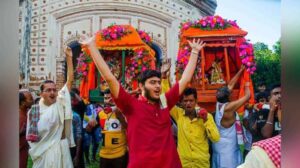
According to Bengali folklore, Lord Jagannath, Balarama, and Subhadra traveled to their aunt’s home (Mashir Bari) and became so enthralled by the luxurious hospitality and sumptuous food that they delayed their return.
Furious at being left behind, Goddess Lakshmi plotted a raid with Lord Brindaban Chandra and Lord Krishna Chandra. They decided to attack and raid the storeroom (Bhandar) of Mashir Bari, plundering all the royal feast cooked for Jagannath. Deprived of his feast, a defeated Lord Jagannath had no choice but to board his chariot the following day and return home.
4. The Grand Frenzy: How “Bhog Loot” Happens
The ritual is pure folk energy, unscripted and electric.
The Preparation: On the afternoon before Ulto Rath, priests prepare a massive feast using fine Gobindobhog rice, ghee, lentils, seasonal vegetables, and aromatic spices.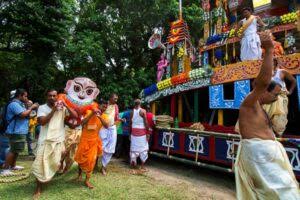
The 400 Pots: Over 400 large earthen bowls (Malsas)—each packed with nearly 5 kg of khichuri, labra (mixed vegetable dish), paneer, payesh, malpua, and traditional Bengali sweets—are arranged across the floor of a designated storeroom inside Mashir Bari.
The Crowd Assembles: Thousands of devotees gather outside the room. Local villagers, historically belonging to the Gop (milkman) community, prepare all day for this intense physical challenge.
The Doors Swing Open: At approximately 5:00 PM, after secret prayers are concluded, the priest flings open all three doors of the storeroom.
The 5-Minute Storm: Hundreds of bare-chested men rush into the room in a massive wave. Within less than five to ten minutes, all 400 pots weighing over 2,000 kilograms of food are completely swept clean! Devotees carry away the heavy earthenware pots on their heads or pass them back through the roaring crowd to family members waiting outside.
Locals believe that taking even a single grain of this looted prasada brings health, prosperity, and divine blessings to the household for the entire year. In fact, many families in Guptipara do not cook at home on that night, dining entirely on the looted bhog.
5. Guptipara Beyond Rath: Culture, Sweets, and Terracotta
Visiting Guptipara during Rath Yatra offers access to several significant Bengali heritage milestones:
-
Birthplace of ‘Barowari’ Puja: In 1790, twelve friends in Guptipara who were barred from a private household Durga Puja pooled their money together to organize Bengal’s first community (Barowari) festival. This birthed the modern community Durga Puja culture celebrated across India today.
- The Legendary ‘Gupo Sandesh’: Guptipara is credited as the birthplace of Gupo Sandesh, widely considered Bengal’s first branded sweet, made of dry, fragrant cow’s milk chhana.
-
Terracotta Temple Complex: The Brindaban Chandra Temple Complex houses four exquisite medieval temples (Chaitanya, Brindaban Chandra, Ramchandra, and Krishnachandra) featuring rare At-chala architecture and colorful wall frescoes.
6. Complete Travel Guide for Guptipara Rath Yatra 2026
How to Reach Guptipara
-
By Train: Take a local train on the Howrah–Katwa line from Howrah Station to Guptipara Station (approx. 2 hours). Auto-rickshaws and toto-rickshaws run frequently from the station to the temple complex.
-
By Road: Drive via the SH-6 highway from Kolkata (approx. 85 km) toward Kalna/Nabadwip.
-
By Ferry: Regular boat services connect Shantipur (Nadia district) across the Hooghly River directly to Guptipara Ghat.
Tips for Spectators
-
Timing for Bhog Loot: Arrive at Mashir Bari by 1:00 PM on the day before Ulto Rath to secure a safe viewing spot.
-
Safety First: The Bhog Loot is extremely physical and crowded. If traveling with children or senior citizens, view the event from an elevated verandah or rooftop nearby rather than standing near the main doorway.
-
Food Experience: Don’t leave without tasting authentic Gupo Sandesh from the historic sweet shops near the temple complex.
Conclusion: A Feast of Unbroken Devotion
The Guptipara Rath Yatra and its wild Bhandar Loot prove that spiritual traditions in India are as diverse as they are ancient. Here, devotion is not passive—it is energetic, theatrical, and communal. As hundreds of devotees charge through the doors of Mashir Bari to carry home a pot of sacred khichuri, they carry forward a 280-year-old living memory that continues to define the soul of Bengal.