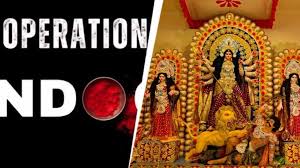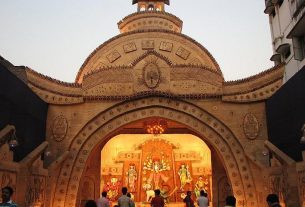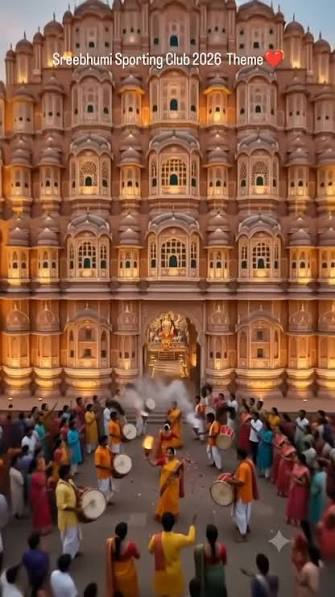
When autumn arrives in Kolkata, the Lake Town and VIP Road bypass corridor transforms into the grandest celebration hub of the city. Standing tall as the undisputed crown jewel of big-budget, opulent theme architecture, Sreebhumi Sporting Club continues its decades-long legacy of spectacular celebrations. Under the guidance of state minister and club president Sujit Bose, Sreebhumi draws millions of devotees and festival-goers every year. In 2026, Sreebhumi brings royal Rajasthani grandeur directly to Kolkata, recreating Jaipur’s iconic palace architecture alongside traditional divine idol sculpting.
Theme Details: Recreating Jaipur’s Regal Hawa Mahal
For Durga Puja 2026, Sreebhumi Sporting Club has chosen the theme of Hawa Mahal (The Palace of Winds), bringing Jaipur’s world-famous Rajasthani palace heritage to North-East Kolkata.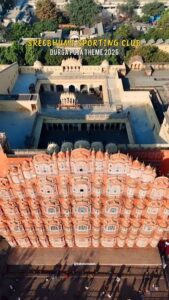
Historically built in 1799 by Maharaja Sawai Pratap Singh, the original Hawa Mahal in Jaipur is famous for its intricate honeycomb facade, featuring 953 small carved windows (jharokhas) designed to allow cool breeze to circulate continuously. Sreebhumi’s artistic team recreated this architectural landmark on a massive scale along VIP Road. The pandal facade stands multi-stories high, painted in signature terracotta-pink tones and detailed with delicate lattice woodwork, domed pavilions, and royal arches.
The interior installation guides visitors through grand courtyard corridors designed like royal palace chambers, leading into a illuminated sanctum that celebrates both royal Indian heritage and sacred faith.
Artist Details: Master Craftsmanship and Idol Sculpting
Executing a royal theme of this scale requires extraordinary artistic direction and legendary idol craftsmanship.
-
Pandal Architecture & Lighting Design: The grand structural fabrication of Hawa Mahal was brought to life by master decorator crews and lighting engineers who specialize in large-scale architectural replicas. The outer structure features thousands of synchronized LED light fixtures, illuminated chandeliers, and warm golden floodlights that highlight the intricate jharokha windows during night hours.
-
Idol Artist – Sculptor Pradip Rudra Pal: The magnificent idol of Goddess Durga and her divine children was sculpted by legendary Kumartuli artist Pradip Rudra Pal (alongside Bhaskar Sri). Known for traditional, expressive sabeki idol sculpting, Pradip Rudra Pal crafted the deity with regal features, serene wide eyes, and traditional clay drapery. In keeping with Sreebhumi’s iconic legacy, the Goddess radiates timeless divine majesty within her royal palace setting.
Pandal Design and Sensory Experience
Stepping onto the approach road of Sreebhumi Sporting Club feels like approaching a royal citadel. The outdoor pathway features majestic archways and Rajasthani folk art panels that set the stage before visitors even reach the main marquee facade.
Inside the pandal, the acoustic design blends classic royal Rajasthani folk instruments—such as the sarangi, shehnai, and nagada—with traditional Bengali dhak beats and devotional chants. The combination of cool air circulation, soft incense scents, grand crystal chandeliers, and warm pink lighting creates a breathtaking, regal atmosphere.
Visitor Guide and Location Details
Because Sreebhumi Sporting Club is one of Kolkata’s most visited Durga Puja pandals, proper planning is essential to handle the massive crowd movement along VIP Road.
-
Exact Address: Sreebhumi Sporting Club, Lake Town / VIP Road Crossing, Kolkata, West Bengal – 700048.
-
Nearest Metro Station: Belgachia Metro Station or Dum Dum Metro Station (Blue Line). From either station, auto-rickshaws, buses, and taxis operate continuously toward Lake Town Crossing / Sreebhumi.
-
By Bus / Road: Take any bus or feeder auto running along VIP Road (Kazi Nazrul Islam Sarani) heading toward the airport, and get down at the Sreebhumi / Lake Town VIP Crossing.
-
Best Time to Visit: Sreebhumi opens early in Devi Paksha and experiences heavy crowds throughout the day. To avoid long queues, visit during the early morning hours (5:00 AM – 8:30 AM). For those who want to experience the full lighting spectacle of Hawa Mahal, late-night hours (after 2:00 AM) are recommended.