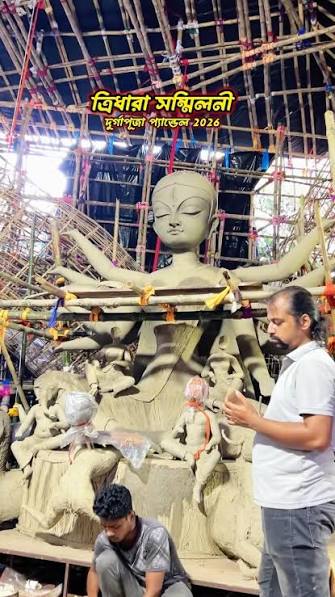
As the familiar beats of the dhak echo across the avenues of South Kolkata, the city sheds its daily routines to transform into a breathtaking open-air celebration of art, philosophy, and devotion. Among the vanguard of South Kolkata’s celebrated “big-budget” community pujas, Tridhara Sammilani (Tridhara Akalbodhan Durgotsav) occupies a coveted pedestal. Located at the bustling intersection of Manoharpukur Road near Deshapriya Park, this iconic institution—celebrating its 76th year in 2026—has earned international acclaim for turning complex philosophical ideas into captivating physical installations.
For Durga Puja 2026, Tridhara Sammilani presents its ambitious conceptual masterpiece: Bhabna O Prakriti (Perspectives, Human Thought, and Mother Nature). Fusing human perspective, environmental equilibrium, and cosmic energy, the marquee invites visitors on a contemplative journey. It offers a peaceful sanctuary where urban rush gives way to cosmic stillness, self-reflection, and ecological awareness.
The Core Philosophy: Human Perception Meets Cosmic Balance
The underlying narrative of Bhabna O Prakriti stems from an urgent contemporary reality—the growing disconnect between human civilization’s inner thoughts (Bhabna) and the natural world (Prakriti). In Sanskrit philosophy, Prakriti is not merely the physical landscape of trees, rivers, and mountains; it represents the primal cosmic energy (Shakti) that drives all creation, preservation, and transformation.
Tridhara Sammilani explores how human thoughts and technological ambitions have disrupted Earth’s delicate ecological balance. The installation asks a fundamental question: Can humanity reshape its internal perspective to realign with the cosmic rhythm of the universe? Through abstract architectural forms, geometry, and spatial design, the pandal guides visitors through three distinct emotional phases—moving from the chaotic noise of human ego toward a deep, humbling realization of Mother Nature’s supreme, protective embrace.
Eco-Conscious Architecture and Sustainable Materials
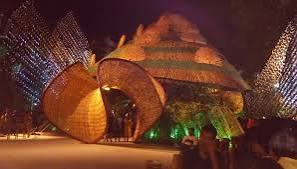
In true alignment with its environmental theme, Tridhara Sammilani prioritizes sustainable, earth-friendly craftsmanship. Rather than relying on synthetic plastics, toxic paints, or non-biodegradable foam, the structural marvel is constructed almost entirely from upcycled, organic materials sourced directly from rural Bengal.
The outer facade and inner chambers incorporate raw bamboo framing, unbleached jute yarn, dried botanical pods, woven coconut coir, terracotta tiles, and unbaked river silt clay. Artisans have spent months carefully hand-weaving intricate geometric patterns that mimic natural forms—fibonacci spirals found in seashells, leaf vein lattices, and cosmic stellar clusters. The neutral, earthy color palette—dominated by warm ochres, deep terracottas, forest greens, and riverbed greys—accentuates the raw, organic beauty of the natural world, demonstrating that world-class installation art can exist in total harmony with Mother Earth.
Sensory Experience: Lighting and Ambient Soundscape
Stepping into the Tridhara Sammilani pandal is an immersive, multi-sensory experience designed to calm the mind and awaken the spirit. The spatial flow forces visitors to naturally slow their stride, creating a quiet corridor where thousands of devotees move together in reverent awe.
-
Lighting Design: Moving away from harsh, glaring stadium lights, the installation utilizes soft, indirect warm-toned LEDs and optical fiber accents. Light filtered through woven jute and clay lattices creates dynamic patterns of shadow and light across the walls, symbolizing the dance between human consciousness and cosmic energy.
-
Acoustic Landscape: The ambient soundscape plays a crucial role in deepening the theme. The chaotic noise of Kolkata traffic fades, replaced by a custom sound composition that blends soft Indian classical flute notes, acoustic singing bowls, resonant om chants, the gentle trickling of flowing water, and rustling forest leaves. As visitors approach the central sanctum, these natural sounds merge seamlessly with the deep, rhythmic beat of traditional Bengali dhak drums.
The Divine Manifestation: Goddess Durga as Cosmic Shakti
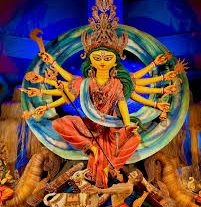
At the heart of the installation sits the magnificent idol of Goddess Durga, sculpted to embody Prakriti itself—the supreme cosmic force of the universe. Departing from overly commercialized or aggressive depictions, the deity radiates immense maternal warmth, meditative calm, and protective strength.
Sculpted using sacred Ganges silt, the idol features wide, soulful eyes that project deep wisdom and peace. She sits enveloped by abstract representations of the five fundamental elements of existence (Pancha Mahabhuta): Earth (Prithvi), Water (Jal), Fire (Agni), Air (Vayu), and Space (Akasha). The traditional weapons in her hands are artfully stylized as symbolic instruments of cosmic balance, reminding devotees that divine strength ultimately exists to restore peace, protect nature, and preserve life.
Visitor Guide and Location Details
Tridhara Sammilani is an essential stop on any South Kolkata Durga Puja pandal-hopping route, easily pairing with nearby landmark pujas such as Singhi Park, Ekdalia Evergreen, Chetla Agrani, and Badamtala Ashar Sangha.
-
Address: 107, Manoharpukur Road, Kalighat, Kolkata, West Bengal – 700029 (Near Priya Cinema & Deshapriya Park).
-
Nearest Metro Station: Kalighat Metro Station or Jatin Das Park Metro Station (Blue Line). From either station, the pandal is a short 5- to 8-minute walk down Rashbehari Avenue toward Manoharpukur Road.
-
Best Time to Visit: To appreciate the intricate sustainable artwork and details in peace, visit during the early morning hours between 5:00 AM and 8:30 AM. For photographers and travelers eager to experience the full lighting and acoustic ambiance, late-night hours (after 1:30 AM) offer an unforgettable view with lighter crowds.